Crown Court trial procedure: the stages from jury selection to verdict
 Save
A Crown Court trial in England and Wales follows a structured sequence that begins with selecting twelve jurors and ends with a verdict or, where the jury cannot agree, a retrial. The process is adversarial: prosecution and defence present their cases to the jury, with the judge overseeing procedure and ruling on law. HS Criminal Law breaks down each stage so you know what happens, who speaks and when the jury decides.
The courtroom and its participants
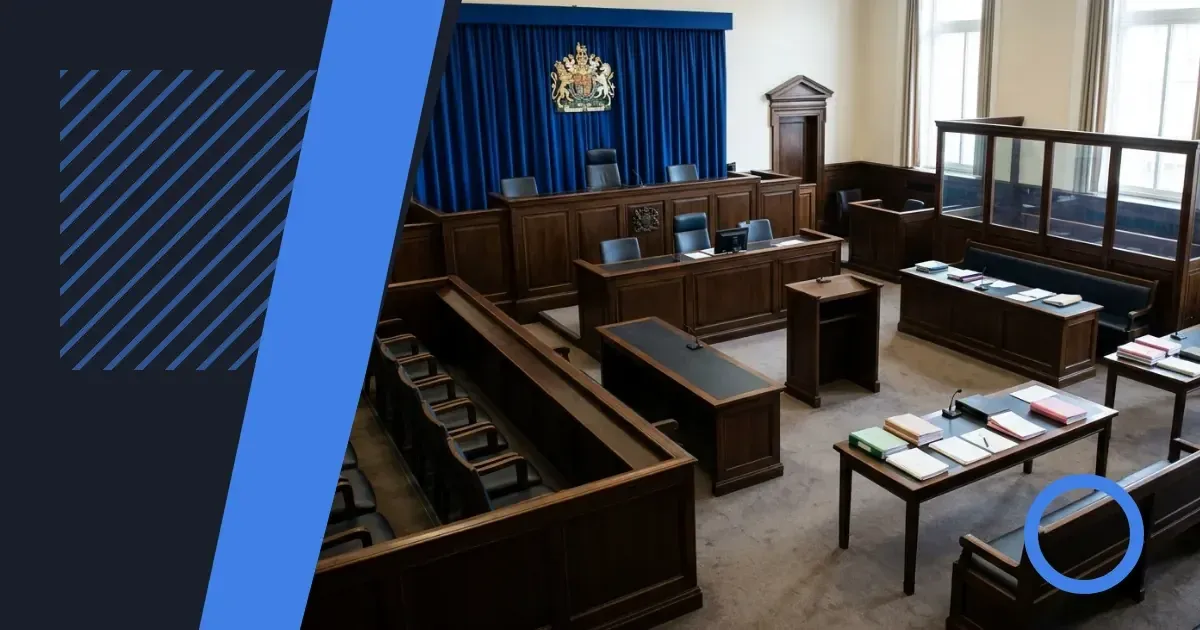
The Crown Court hearing takes place in a formal courtroom where seating reflects each person's role. The judge sits elevated at the front, the jury occupies a box to one side, and the defendant sits in the dock with a dock officer nearby. Barristers for prosecution and defence sit at tables facing the judge, with solicitors behind them. Witnesses give evidence from a witness box, and members of the public and press may sit in a gallery.
The judge controls what happens and when, rules on whether evidence can be heard, and instructs the jury on the law. The jury decides guilt or innocence based on the evidence presented. Barristers argue the case; they question witnesses, make speeches and raise objections. The defendant remains mostly silent unless they choose to give evidence.
Jury selection and swearing in
The trial begins with selecting twelve jurors from a larger pool summoned to court. Names are drawn at random, and each potential juror takes a seat in the jury box. Both prosecution and defence may challenge a juror, though only the prosecution can do so without giving a reason, and this right is used sparingly.
Once twelve jurors are seated, they take an oath or affirmation to try the case faithfully according to the evidence. The clerk reads the indictment aloud – the formal document listing the charges – and asks the defendant to plead guilty or not guilty to each count. A not guilty plea moves the trial forward; a guilty plea at this stage means no trial, and the judge proceeds to sentencing.
The role of the jury foreperson
After being sworn, the jury selects one member as foreperson. This person chairs jury discussions in private, asks the judge questions on behalf of the group if needed, and delivers the verdict in open court. The foreperson has no greater authority in deciding guilt; they simply coordinate the process.
Opening speeches
Prosecution goes first. The barrister outlines what the case is about, what the defendant is alleged to have done, and what evidence will be called to prove each charge. This speech is not evidence itself; it tells the jury what to expect and what the prosecution must prove beyond reasonable doubt.
Defence may make an opening speech immediately after, or wait until prosecution evidence has finished. Many choose to wait. When delivered, the defence opening explains what is disputed, what alternative account the jury will hear, and why the prosecution case falls short.
Prosecution evidence
Prosecution calls its witnesses one at a time. Each witness enters the witness box, takes an oath or affirmation, and answers questions first from the prosecution barrister. This is examination-in-chief: the barrister cannot ask leading questions that suggest the answer, and the witness speaks from memory or, where permitted, refreshes it from a statement made closer to the events.
Once examination-in-chief finishes, the defence barrister cross-examines the witness. Here, leading questions are allowed, and the purpose is to challenge credibility, highlight inconsistencies or show that the witness's account supports the defence case. Cross-examination can be brief or lengthy depending on what the witness claims.
Types of prosecution witness
Witnesses include civilians who saw or heard something relevant, police officers who conducted the investigation or made the arrest, and expert witnesses who give opinion evidence on technical matters such as forensic findings or medical cause. Expert evidence must stay within the expert's field, and the judge decides whether it is admissible before the jury hears it.
Defence case
When prosecution evidence closes, the defence may submit that there is no case to answer – arguing that even taken at its highest, the evidence cannot prove the charge. The judge rules on this without the jury present. If the submission succeeds, the jury is directed to acquit. If it fails, or if no submission is made, the defence case begins.
The defendant is not required to give evidence. Silence is not proof of guilt, though the judge will tell the jury they may draw an adverse inference from it in certain circumstances. If the defendant does testify, they are examined by their own barrister, then cross-examined by the prosecution. The defendant faces the same scrutiny as any other witness.
Defence may call other witnesses – character witnesses, alibi witnesses or experts who challenge prosecution findings. Each is examined and cross-examined in turn. The order of questioning remains the same: the party calling the witness goes first.
Closing speeches
After all evidence is heard, each side makes a closing speech summarising its case. Defence speaks first this time, followed by prosecution. Each barrister reviews the evidence, highlights strengths in their own case and weaknesses in the other, and reminds the jury what must be proved and to what standard.
Closing speeches are persuasive, but they are not evidence. The jury must base its decision on what it heard from the witness box and what exhibits were admitted, not on what the barristers say about them.
Judge's summing up
The judge then sums up the case. This involves two parts: directions on law and a summary of evidence. The legal directions explain what each charge requires the prosecution to prove, what defences are raised, and what reasonable doubt means. The jury must follow these directions.
The summary of evidence reviews what each witness said, but the judge reminds the jury that it is their recollection that counts, not the judge's. The judge may comment on the evidence – pointing out conflicts, suggesting what may be significant – but makes clear that the jury is the master of fact and may accept or reject any comment.
Written directions and jury questions
The judge often provides written directions the jury can take into the jury room. If the jury has a question during deliberations, it sends a note to the judge, who recalls both sides, reads the question in open court and answers it with barristers present.
Jury deliberation and verdict
The jury retires to a private room to discuss the case. Deliberations are secret, and no one else is present. The jury must reach a verdict on each count of the indictment. Initially, the verdict must be unanimous – all twelve jurors must agree.
If the jury cannot reach a unanimous verdict after a reasonable time, the judge may recall them and give a majority direction, allowing a verdict of ten or eleven jurors to be accepted. If even a majority cannot be reached, the judge may discharge the jury and order a retrial with a new jury, or the prosecution may choose not to proceed further.
Delivering the verdict
When the jury reaches a verdict, it returns to the courtroom. The clerk asks the foreperson whether they have reached a verdict on which at least ten of them agree, and if so, whether the defendant is guilty or not guilty on each count. The foreperson answers aloud. A guilty verdict leads to sentencing, either immediately or at a later date. A not guilty verdict means the defendant is acquitted and free to leave.
Steps to prepare if you are facing trial at Crown Court
- Instruct a solicitor early. They will brief a barrister for you, gather evidence and explain each stage before it happens.
- Review the evidence against you. Prosecution must disclose its case in advance; read the statements, watch any video evidence and discuss weaknesses with your legal team.
- Decide whether to give evidence. Your barrister will advise, but the choice is yours; consider what you gain and what you risk under cross-examination.
- Prepare for the formality. Crown Court procedure is strict; address the judge as "Your Honour" or "My Lord" or "My Lady", stand when the jury enters or leaves, and follow instructions from the dock officer.
The difference between judge and jury roles
The jury decides whether the prosecution has proved its case beyond reasonable doubt. It is the sole judge of fact: what happened, who to believe, what inferences to draw. The judge rules on law and procedure: what evidence is admissible, what each offence requires, how the jury should approach its task. This division is fundamental to the Crown Court trial process.
| Question | Decided by |
|---|---|
| Did the defendant commit the act alleged? | Jury |
| Is this witness telling the truth? | Jury |
| Can the jury hear this evidence? | Judge |
| What does the law require to prove this charge? | Judge |
The jury's verdict must rest on evidence admitted by the judge. If the judge rules that a piece of evidence cannot be heard, the jury must disregard it, even if it was mentioned before the ruling. This is why legal arguments often take place in the jury's absence.
What happens if the jury cannot agree
A hung jury occurs when, even after majority directions, fewer than ten jurors agree on a verdict. The judge discharges the jury and the trial ends without a verdict. Prosecution then decides whether to seek a retrial with a fresh jury, proceed on some counts only, or offer no evidence and allow the defendant to be acquitted.
Retrials follow the same procedure, though evidence may differ where witnesses have since become unavailable or new disclosure has emerged. The defendant is not penalised for the earlier jury's failure to agree; the new jury hears the case without knowing what happened at the first trial.
After the verdict
A not guilty verdict is final. The defendant cannot be tried again for the same offence, and prosecution cannot appeal against an acquittal. A guilty verdict leads to sentencing, which may happen immediately if the case is straightforward, or be adjourned for reports – typically a pre-sentence report prepared by probation, and sometimes psychiatric or other specialist assessments.
The defendant may appeal a conviction if there are grounds to believe the trial was unfair or the verdict unsafe. Appeals against sentence are also possible if the punishment imposed was wrong in law or manifestly excessive. Time limits apply, and permission to appeal must be sought from the Court of Appeal.
Download PDF: Crown Court trial preparation checklist PDF, 28 KB
Further reading
Frequently asked questions
How long does a Crown Court trial take?
The length depends on the complexity of the case and the number of witnesses. A straightforward trial may finish in a few days; a case involving multiple defendants or technical evidence can run for weeks. The court sits from mid-morning to mid-afternoon on weekdays, with breaks.
Can I choose whether to have a jury trial?
No. Jury trials happen only at Crown Court, and you appear there because the offence is too serious for the magistrates' court or because you elected Crown Court trial for an either-way offence. Summary-only offences are tried by magistrates without a jury.
What happens if a juror knows the defendant?
If a juror recognises the defendant or a witness, they must tell the judge immediately. The judge will usually discharge that juror and continue with the remaining members, provided at least twelve remain after any discharge. If the connection is significant, a new trial before a fresh jury may be ordered.